Studies have shown that neither vaccination nor previous SARS-CoV-2 infections provide lasting immunity against infection with the Omicron variant. The increase in immunity achieved through booster vaccinations is also not sustained over time. However, vaccinations and previous SARS-CoV-2 infections do protect against severe or even fatal courses of the disease, including infections with Omicron. So far, however, their effect on the duration of mild infections has remained unknown.
To investigate this, we surveyed DigiHero participants during the winters of 2022/23 and 2023/24 about their SARS-CoV-2 infections, the duration of their symptoms, the number of days spent in bed, and their vaccination history. A total of 13,615 participants reported having experienced COVID-19. Information on the duration of symptoms was provided for 4,788 infections during the winter of 2022/23 and for 4,787 infections during the winter of 2023/24. We defined infections without a reported hospital stay as mild cases. In our analyses, episodes lasting ≤21 days were classified as short mild infections, while episodes lasting >21 days were classified as prolonged mild infections.
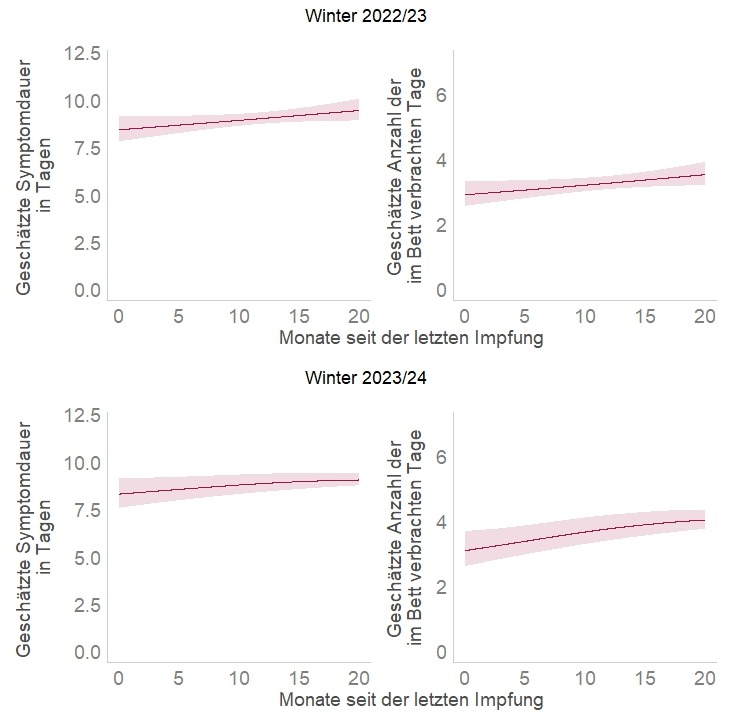
On average, participants reported symptom durations of 8.6 days for short mild infections during the winter of 2022/23 and 9.0 days during the winter of 2023/24. Our results showed that the number of vaccinations had no effect on the duration of short mild infections (≤21 days of symptoms). For short mild infections, we observed only a slight increase in symptom duration (2%) and the number of days spent in bed (4%) for every additional six months since the last vaccination in both winters (Figure 1). A similar effect was observed for the time since the last infection. In this case, symptom duration increased by 3% and the number of days spent in bed by 4% for every additional six months since the last infection.